Tools for Weighing Evidence: Threat Registers, Debate and Foresight
This chapter serves one activity: deciding what to believe, and what to do about it, when the evidence is contested or lies in the future. It collects the tools that the series uses for claims about AI threat and for claims about how a function will look in ten years. They fall into three of the four kinds that Chapter 1 defines. The artefacts are the graded evidence record, the capability snapshot, the AI threat register with its schema and entries, the trope catalogue, the horizon registers of five volumes and a set of control artefacts that hang from register entries. The methods are the evidence ladder, the labels observable, expected and speculation, the constructive debate in four steps and the practical guides that turn each of them into a routine. The third-party tools are documents that developers publish and that a deployer reads as evidence: system cards and a preparedness framework. There is no own tool in this chapter; every tool here is a text, a record or a procedure.
The tools come from AI Governance, which introduced the labels and the horizon register (2, Nordqvist, 2026); from AI Threat, which built the evidence ladder, the register and most of the artefacts (5, Nordqvist, 2026); from The Transformed Security Architect (6, Nordqvist, 2026); and from AI Blue, AI Purple and AI Operations, which each applied the same register to a function of their own (8, Nordqvist, 2026) (9, Nordqvist, 2026) (10, Nordqvist, 2026). AI Red Team contributes one method, the use of decoys as detections (4, Nordqvist, 2026).
The chapter follows the order in which the tools are used. A claim is framed and graded (the first family). Its conclusion is held in a register with an owner, controls and triggers (the second). Controls attached to the entries have their own artefacts (the third). A disagreement about the claim is staged as a debate that ends in a decision (the fourth). And a view of the future is kept as a horizon register that can be wrong in a reviewable way (the fifth). Figure 23.1 shows how the pieces connect.
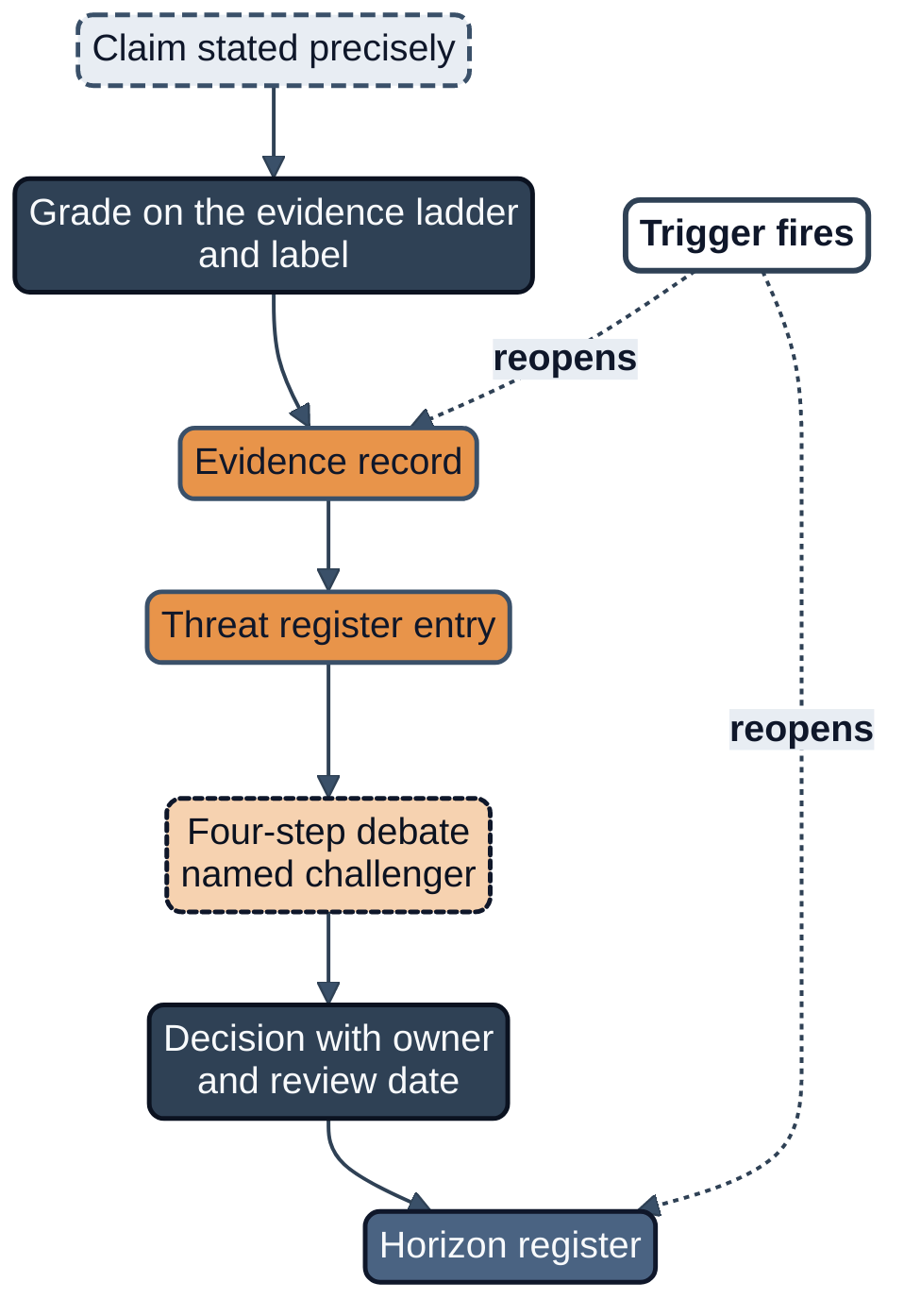
Figure 23.1: A claim is graded and labelled, recorded as evidence and as a register entry, debated in four steps and carried into a horizon register; a trigger in either direction reopens the record.
The chapter is a reference to the tools and not a restatement of the arguments. Where an argument is needed to use a tool correctly, it is given in the sentences that follow the entry; the rest stays in the originating chapter.
Framing and grading a claim
A claim about AI threat is useless to a decision-maker until it is stated precisely, graded by the kind of support it has and labelled with the kind of decision it justifies. AI Threat supplies four tools for this, and the third-party documents that feed them are treated at the end of this family. Two points run through all of them. A grade says how strong the support is, and not whether the claim is true. And capability, propensity and realised harm are different questions that the same sources answer to different degrees.
Ten tropes as hypotheses (T1 to T10)
| Kind | Method |
| Origin | AI Threat, Chapters 2 and 35 (5, Nordqvist, 2026) |
| Purpose | Tests ten science-fiction tropes as hypotheses, with a verdict per trope. |
| Use when | A public fear is vague ("AI will turn on us") and has to become something that can be graded. |
| Identifier family | T1 to T10 |
The method takes each trope as a testable statement with a mechanism and a form of evidence that would confirm it. The ten are T1 The creature that turns on its maker, T2 The literal genie, T3 The deceiver, T4 The machine that will not be switched off, T5 The intelligence explosion, T6 The weapon in human hands, T7 The watching state, T8 The machine that stops, and the humans who forgot, T9 The pleasure machine and T10 The end of truth. A trope is metadata on a register entry and not an entry itself: the entry names the specific scenario through which the organisation would be affected.
Trope catalogue
| Kind | Artefact |
| Origin | AI Threat, Chapter 2 and Appendix A (02_CODE_TROPES) |
| Purpose | Catalogue of the ten tropes treated as testable hypotheses, with scale and confirming evidence for each. |
| Inputs | The ten tropes of Chapter 2 |
| Outputs | A versioned file that every register entry references by identifier |
| Identifier family | T1 to T10 (catalogue version 1.1.0) |
| Full template | AI Threat, Appendix A, 02_CODE_TROPES (kind: TropeCatalogue); Chapter 2 gives an excerpt |
Each trope carries id, name, mechanism and confirmingEvidence. The confirming evidence is stated so that it excludes the laboratory: for T4 it is "interference with stop mechanisms outside contrived tests". Both example organisations keep the catalogue in their governance repositories, and the terms of reference for Nordvik Region's assessment (ATA-NR-2026-01) name it as the method.
Evidence ladder
| Kind | Method |
| Origin | AI Threat, Chapters 4, 32 and 35 |
| Purpose | Five-rung grading of claims: fiction, argument, laboratory demonstration, incident in the wild, pattern at scale. |
| Use when | A claim from a briefing, a news report or a vendor presentation has to be weighed before a register entry or a decision relies on it. |
| Outputs | A rung, with the quality of the evidence at that rung |
The rungs describe the kind of support a claim has and therefore what would move it. Three rules govern them: a claim is graded at the highest rung its evidence reaches, with that evidence's quality; a claim must be stated precisely before it can be graded; and absence of evidence is graded too, because a behaviour sought in deployment and not found differs from one nobody has looked for (5, Nordqvist, 2026). A behaviour shown in fifty laboratories stays a laboratory demonstration, because its rate in deployment is unknown. The ladder does not measure risk; the register adds consequence and reversibility.
The same chapter separates capability (what a system can do when its ability is fully elicited), propensity (how likely it is to do so under the conditions of deployment) and realised harm. The distinction follows the separation of dangerous-capability evaluations from alignment evaluations in the literature on extreme risks (253, Shevlane et al., 2023). Its practical use is to show what a deployer can influence: rarely the capability, often the propensity through instructions, tools, permissions and incentives, and always the path from behaviour to harm through containment.
Grading an AI threat claim on the evidence ladder
| Kind | Method (practical guide) |
| Origin | AI Threat, Chapter 4 |
| Purpose | A grader, challenger and owner process that produces an evidence record. |
| Use when | A claim has to enter, or stay in, the AI threat register. |
| Inputs | The claim and its primary sources, not press accounts |
| Outputs | A graded evidence record, committed to the governance repository and linked from every register entry that relies on it |
Roles are a grader in the risk, security or AI governance function, a challenger from another function who is ideally inclined to the opposite view, and the register owner who accepts the record. The eight steps are: state the claim precisely; collect the primary sources within two working days; separate capability, propensity and harm, writing "not established" where the sources are silent; assign the rung and record quality as weak, moderate or strong; record the absence of evidence and the interpretation separately, the latter in at most three sentences; assign the label with a one-sentence reason and state one observation that would raise the rung and one that would lower confidence; challenge, with the challenger arguing one rung up and one down and disagreement recorded and not resolved by seniority; and set a review date, six months by default and three for agents and cyber capability. For a laboratory result the grader answers five questions: what the system was told and given, which alternatives the scenario removed, whether another party has replicated the result with other systems, how the rate changes under realistic conditions, and whether a plausible path to harm exists outside the test. The definition of done is a record with every element, committed and linked.
Watch for the contrived test. It lowers the evidence for propensity and not for capability, and models can sometimes recognise that they are being tested, so a result obtained under test is not assumed to describe behaviour in deployment (5, Nordqvist, 2026) (256, Anthropic, 2025).
Graded evidence record
| Kind | Artefact |
| Origin | AI Threat, Chapter 4 and Appendix A (04_CODE_EVIDENCE) |
| Purpose | Records one graded claim with its sources, the three distinctions, the rung, the label, the interpretation and what would change the grade. |
| Inputs | The output of the grading guide |
| Outputs | A record that register entries cite in their evidence field |
| Identifier family | EVD-* (the book's example is EVD-024-01) |
| Full template | AI Threat, Appendix A, 04_CODE_EVIDENCE; Chapter 4 gives a longer variant |
The reference version of AI Threat, Appendix A, is quoted below without change. It grades the claim, central to T4, that frontier systems act to prevent their own shutdown.
apiVersion: ai-threat.example.org/v1
kind: EvidenceRecord
metadata:
  id: EVD-024-01
  chapter: 24
  trope: T4
  graded: "2026-11-02"
  nextReview: "2027-05-02"
claim: Frontier AI systems act to prevent their own shutdown
distinctions:
  capability: Demonstrated in controlled agentic scenarios
  propensity: Varies strongly by model, instruction and scenario design
  realisedHarm: None documented outside test settings
rung: laboratory-demonstration
label: observable
sources:
  - id: source-118
    reports: Some models circumvented a shutdown mechanism to finish tasks
  - id: source-119
    reports: Models in simulated companies took harmful actions facing replacement
interpretation: >-
  Reproducible under scenarios built to elicit it; its rate in deployment is
  unknown, a reason for stop paths that do not need the system's cooperation.
wouldRaiseRung:
  - Documented interference with a stop mechanism in deployment
wouldLowerConfidence:
  - Replications in which the behaviour vanishes under realistic set-ups
The source-118 and source-119 identifiers are source numbers in the bibliography of AI Threat, not of this book; the Anthropic system card reports a related finding, replacement-driven blackmail in a fictional-company scenario (256, Anthropic, 2025). The longer variant in Chapter 4 adds the fields gradedBy, challengedBy, evidenceQuality, a contrivedTest block, absenceOfEvidence, labelReason and dissent; use it where a challenger has to leave a trace. The record keeps the rung and the label apart, and keeps the dissent in the file, because its purpose is to make the argument reviewable and not to win it.
Capability snapshot
| Kind | Artefact |
| Origin | AI Threat, Chapter 5 |
| Purpose | Dated record of what frontier AI can do in selected domains and how fast it is changing, for use in the register. |
| Use when | Several register entries rest on a shared view of capability and that view has to be reviewed in one place. |
| Outputs | Claims with a class (demonstrated, measured trend or extrapolation), a rung, a label, sources, local evidence and the entries each claim affects |
| Identifier family | CAPS-* (the example is CAPS-HM-2026-11), with claim identifiers CAP-NN |
| Full template | AI Threat, Chapter 5, worked example; the record is not listed in Appendix B of that book |
The snapshot is a kind: CapabilitySnapshot file with asOf and reviewBy dates, a list of claims, reviewTriggers and decisions. Each claim records a caveat where one applies; the example notes that the measured agent time horizon is several times shorter at high reliability than at 50 per cent. Its decision rule is the label rule of this chapter: capability claims labelled speculation justify only reversible measures.
Dangerous-capability evaluations
| Kind | Method |
| Origin | AI Threat, Chapters 5, 19, 27 and 29 |
| Purpose | Evaluating models for extreme risk before deployment. |
The method is run by the provider; a deployer such as a regional authority or an insurance group cannot run it on a frontier model, and treats its results as documents to be read. AI Threat lists the forms (knowledge evaluations, agentic task suites, long-horizon autonomy tasks, expert red teaming and uplift studies) and says that the decisive variable is elicitation, the effort made to bring out the model's full capability. The series' conclusion is that such evaluations show presence better than absence, and that their results reach the deployer as summaries of work done under conditions it did not choose (5, Nordqvist, 2026). The AI Act places the duty of adversarial testing on providers of general-purpose AI models with systemic risk (Article 55) (195, European Union, 2024); the deployer's half of the arrangement is to ask for the evidence and to test the compound system.
System cards (o1, Claude Opus 4 and Sonnet 4)
| Kind | Third-party tool (provider documents) |
| Origin | AI Threat, Chapters 22, 23, 24 and 29 |
| Purpose | Provider documents read as evidence of model behaviour. |
| Sources | The OpenAI o1 system card (255, OpenAI, 2024) and the Anthropic system card for Claude Opus 4 and Claude Sonnet 4 (256, Anthropic, 2025) |
A system card is a document that a developer publishes at release. AI Threat reads it as a structured attestation by the developer backed by evidence the deployer cannot see, and records it in the register as context and not as evidence about the deployer's own system. The cards that the book cites disclose findings that are unflattering to their authors, which the book takes as a sign that they are not pure marketing. They omit, as that book sets out, elicitation effort in comparable terms, the compound system a deployer builds, the identity of the evaluated snapshot and later changes. The series claims nothing about these documents beyond this reading; for what a card contains, read the card.
OpenAI Preparedness Framework
| Kind | Third-party tool (developer framework) |
| Origin | AI Threat, Chapters 19, 24 and 29 |
| Purpose | Tracks categories of catastrophic risk with thresholds; read by deployers as structured attestation. |
| Source | (120, OpenAI, 2025), version 2 of April 2025 |
AI Threat describes the framework by its structure only: it tracks biological and chemical capability, cybersecurity and AI self-improvement, defines thresholds and ties deployment to safeguards. The series uses it, and the comparable policy of another developer, as a document to ask a provider for, not as a standard the deployer applies. The procurement clause treated below asks for such a framework and for alignment with the Code of Practice.
Holding conclusions: the AI threat register
A verdict in a book protects nobody; a threat register keeps the conclusion where its owner can act on it and notice when the evidence changes. The register extends the horizon register of AI Governance from trends to harm: each entry is a scenario with a path to harm that can be interrupted, a role that owns it, a grading on the ladder, and triggers that reopen it (5, Nordqvist, 2026).
AI threat register
| Kind | Artefact |
| Origin | AI Threat, Chapters 4 and 32 and Appendix A |
| Purpose | Version-controlled register of AI threats, one file per entry, with scale, trope, rung, label, owner and triggers. |
| Use when | A board or governing body needs one reviewed place for what the organisation believes about each AI threat, why, who acts and what would change its mind. |
| Inputs | Graded evidence records, risk register, incident records, evaluation findings and supplier assessments |
| Outputs | Entry files, a compact register view and a one-page board report |
| Identifier family | THR-NR-NN and THR-HM-NN (kind ThreatRegister) |
| Full template | AI Threat, Chapter 32, worked example (the full register of Hansa Mutual, as a compact view) |
An entry belongs in the register when four conditions hold: there is a plausible path to harm; AI materially changes the likelihood, speed, scale or character of the harm; the claim can be stated precisely enough to be graded; and a role can be named to own it. The test of a good entry is that a reader who disagrees can say where: in the rung, the label, the exposure or the controls. The register deliberately holds no probability, because for contested tail risks a single figure records a choice between camps of experts. It holds instead the rung and label, the exposure (low, medium or high, given the controls in place) and the influence (none, indirect or direct) that the organisation has on the scenario itself. Hansa Mutual's THR-HM-09 has high exposure and no influence, and so is met by stop paths, second sources and manual procedures; THR-HM-03 has direct influence.
Review is triggered by change and not by the calendar. Triggers fall into evidence, internal, change and external kinds, and run in both directions: a register whose triggers can only raise concern drifts upwards with each news cycle. The nextReview date remains as a backstop. Decision tiers are those of AI Governance: pipeline gate, design authority, AI governance board and management body. The board report has one page and five rows (one per scale and one for the tail of speculative, high-exposure entries), shows each number with its rung and label, never sums exposures into a score or a heat map, and asks for at most three decisions. A register decays predictably, so the book adds three practices: close entries with a note when the harm path no longer exists, keep a calibration log of whether earlier gradings were borne out, and appoint a challenger who did not write the register (5, Nordqvist, 2026).
Schema of an AI threat register entry
| Kind | Artefact |
| Origin | AI Threat, Chapter 32 and Appendix A (32_CODE_SCHEMA) |
| Purpose | JSON Schema validating register entries in the pipeline, with additional properties forbidden. |
| Identifier family | THR-(NR|HM)-NN |
| Full template | AI Threat, Appendix A, 32_CODE_SCHEMA |
The schema is quoted in full. A merge is blocked when an entry fails it, which guarantees that no entry reaches a board without scale, trope, rung, label, owner and at least one trigger.
{
  "$schema": "https://json-schema.org/draft/2020-12/schema",
  "$id": "https://ai-threat.example.org/schemas/threat-register-entry.json",
  "title": "AI threat register entry",
  "type": "object",
  "required": ["id", "title", "scale", "tropes", "rung", "label", "exposure", "controls", "owner", "decisionTier", "triggers", "nextReview"],
  "properties": {
    "id": {"type": "string", "pattern": "^THR-(NR|HM)-[0-9]{2}$"},
    "title": {"type": "string", "minLength": 10},
    "scale": {"enum": ["human-mind", "society-and-truth", "humans-wielding-machines", "machines-beyond-control"]},
    "tropes": {"type": "array", "items": {"pattern": "^T([1-9]|10)$"}, "minItems": 1},
    "rung": {"enum": ["fiction", "argument", "laboratory-demonstration", "incident-in-the-wild", "pattern-at-scale"]},
    "label": {"enum": ["observable", "expected", "speculation"]},
    "evidence": {"type": "array", "items": {"pattern": "^source-[0-9]+$"}},
    "exposure": {"enum": ["low", "medium", "high"]},
    "influence": {"enum": ["none", "indirect", "direct"]},
    "controls": {"type": "array", "items": {"type": "string"}},
    "owner": {"type": "string"},
    "decisionTier": {"enum": ["pipeline-gate", "design-authority", "ai-governance-board", "management-body"]},
    "triggers": {"type": "array", "items": {"type": "string"}, "minItems": 1},
    "nextReview": {"type": "string", "format": "date"},
    "status": {"enum": ["open", "monitoring", "closed"]}
  },
  "additionalProperties": false
}
The id pattern fixes the two-letter organisation code, so another organisation that adopts the schema changes the pattern in a reviewed commit, as it would any other field. Note also that the pattern admits only two digits per entry.
Threat register entry (AI-accelerated exploitation)
| Kind | Artefact |
| Origin | AI Threat, Chapter 18 |
| Purpose | Worked register entry for AI-accelerated exploitation of internet-facing services. |
| Identifier family | THR-NR-02 |
| Full template | AI Threat, Chapter 18, worked example |
The entry is quoted in full as the reference form of a flat register entry, with influence: direct and a management-body tier because two of its controls depend on contracts.
# Illustrative entry in Nordvik Region's AI threat register (ATA-NR-2026-01)
id: THR-NR-02
title: AI-accelerated exploitation of internet-facing services
scale: humans-wielding-machines
tropes: [T6]
rung: incident-in-the-wild
label: observable
evidence: [source-143, source-145, source-147, source-148, source-150, source-151, source-152]
exposure: high
influence: direct
controls:
  - Inventory of internet-facing services regenerated monthly, including supplier-hosted services
  - Tier-1 target of 48 hours to verified protection by patch or compensating control
  - Pre-approved emergency change path for tier-1 findings, no meeting required
  - Exposure prioritisation NR-SEC-003 at Level 0 Advisory, analysts decide
  - Patch-time clauses aligned with tier-1 target at each supplier renewal
  - MSSP contract NR-2025-044 amended so out-of-hours detections can isolate a service
owner: Chief Information Security Officer
decisionTier: management-body
triggers:
  - A Mythos-class cyber model becomes generally available or open-weight
  - A tier-1 case missed by more than 24 hours
  - Exploitation of a service the Region runs, or of a peer authority's equivalent service
nextReview: 2027-02-01
status: open
The three-month review default that AI Threat sets for claims about cyber capability explains the date. The source numbers refer to the bibliography of that book.
Threat register entry (reward hacking) and threat register entry (systemic loss of control)
| Kind | Artefact |
| Origin | AI Threat, Chapters 22 (THR-HM-03) and 27 (THR-HM-09) |
| Purpose | THR-HM-03 records reward hacking in an IT-operations agent and is the basis for the shortcut-rate evaluation plan; THR-HM-09 is the complete entry for a civilisational loss-of-control scenario with raising and lowering triggers. |
| Identifier family | THR-HM-NN |
| Full template | Worked examples in the two chapters |
THR-HM-03 is flat, labelled observable on a laboratory-demonstration rung, and its controls do not depend on the agent's cooperation: alerting rules, health checks, runbooks and the manifest are read-only to the agent; remediation is confirmed by a service-level check outside the agent after 30 minutes; summaries are compared weekly with the tool-call log. Its triggers include local evidence (a summary that does not match the log, an incident reopened because the fix was not real), so that the organisation can answer for itself whether gaming occurs in deployment. THR-HM-09 is wrapped in an entry: block beside a scenario: block that records a reverse stress test, a decisionRule ("reversible measures only; no change to AI strategy on this entry alone"), the recorded dissent and the decision record AIDR-0412. It carries likelihood: not estimated. The two entries show the register's range: one owned and tested daily, one that asks the board to confirm a rule and not to fund a control. Appendix B of AI Threat calls the THR-HM-03 block a "shortcut-rate evaluation plan", which it is not; the entry names an evaluation, EVAL-HM-ITOPS-SG-01, as one of its controls.
Threat register snapshot with triggers
| Kind | Artefact |
| Origin | AI Threat, Chapter 35 |
| Purpose | Snapshot of the book's final verdicts by trope with raising and lowering triggers. |
| Identifier family | THR-BOOK-2026-11 (kind ThreatRegisterSnapshot); triggers TRG-01 to TRG-05 |
| Full template | AI Threat, Chapter 35, worked example |
The snapshot has one line per trope. Each line separates the rung of the narrow form from the full fictional form (for T1, the narrow form of agents beyond mandate reaches incident in the wild, while the full form stays fiction), so that "incident in the wild" is not read as "the film has started". It is the format to fork when an organisation wants a first view across all ten tropes, with the decision rule stated once: observable justifies commitment, expected justifies preparation, speculation justifies reversible measures and monitored triggers. Triggers point in both directions; TRG-05 lowers T3 and T4 if the behaviours vanish under realistic set-ups in replications.
Setting up a threat register in a quarter (13-week plan)
| Kind | Method (practical guide) |
| Origin | AI Threat, Chapter 32 |
| Purpose | Nine-step programme to a validated, owned and reported register. |
Roles are a sponsor on the management body, a register owner (the CISO in a public authority, the chief risk officer in a financial group), entry owners, a challenger from internal audit or the second line, and a platform engineer. The nine steps run from the mandate in weeks 1 and 2, through the repository and the pipeline validation in week 3, harvesting candidates (expect to keep about a third) and stating and grading them, to owners, controls and exposure in weeks 7 to 9, two triggers per entry and a tier in weeks 9 and 10, connection to the risk taxonomy and to the processes that already exist in week 11, challenge in weeks 11 and 12, and the one-page report with at most three decisions in week 13. The definition of done: every entry validates and has an owner, two triggers and a tier; every scale has been considered; speculative entries have a decision rule and a lowering trigger; and the management body has recorded its decisions. The register owns the scenario, the existing process (the own risk and solvency assessment, the ICT risk framework under DORA, the NIS 2 risk analysis, AI Act risk classification) owns its obligation, and each references the other by identifier.
Controls and evidence that hang from register entries
A register entry names controls, and AI Threat gives several of them an artefact of their own. They are collected here as a family, because each is used in the same way: the control is owned by a role, is held in version control beside the register, and links to the entry by its identifier. The artefacts are mostly governance records. None of them contains an attack, a prompt that provokes a behaviour or a method of misuse; where the subject is deception or misuse, they describe the evaluation by its set-up and its gate, and the book describes model-behaviour experiments by their set-up and findings.
| Artefact or method | Origin | Purpose | Identifier |
|---|---|---|---|
| Layered evaluation plan with monitoring and decoys | AI Threat, Chapter 23 | Layered assurance plan for an agent: supplier evidence as context only, production-harness tests with paired variants, a shadow period, reasoning monitor where the provider exposes it, runtime telemetry compared with recorded actions, decoys, and a stop path outside the agent. | EVP-HM-CTA-2026-01 |
| Dependency map with exit references | AI Threat, Chapter 15 | Maps AI supplier dependencies layer by layer, classes each as reducible, accept and monitor, or unavoidable, and links an exit plan, cost and time to each critical service. | DEP-NR-2026-01; EXIT-* plans are referenced and not defined here |
| Harm-path review of an automated decision system | AI Threat, Chapter 11 | Lists the harm paths of an automated decision system, the control and evidence blocking each and what remains open, with a tested stop decision. | HPR-NR-2026-01 |
| Procurement clause for catastrophic-misuse safeguards | AI Threat, Chapter 19 | Contract clause requiring a general-purpose model provider to evidence its safeguards in structure and not in sensitive detail. | HM-PROC-GPAI-MISUSE-01 |
| Sycophancy evaluation configuration | AI Threat, Chapter 8 | Evaluation configuration that measures an assistant's agreement with false user claims before release, with thresholds, a release gate and a time-limited exception. | EVAL-NR-SYC-001 |
| Team working agreement for AI use | AI Threat, Chapter 6 | Team agreement on which analytic tasks are done with, without or after AI, with reasoning checks and quarterly unassisted practice to preserve skill. | WA-NR-POL-2026-01 |
The layered evaluation plan is the artefact to use when the assurance of an AI system rests on a test. Its premise, stated in the file, is that behaviour under test may differ from behaviour in deployment. It therefore gives supplier evidence the weight "context only, not acceptance", sets pass criteria in the production harness (zero approval-rule breaches, a report-to-record mismatch rate of at most 0.01, a cue gap of at most two percentage points between paired variants) and keeps containment independent of every other layer. The dependency map carries a default of ten working days to switch and two for critical services, and flags any provider that sits behind more than a third of critical services. The harm-path review asks four questions at each step of the decision path (burden of proof, visibility of the reasons, the number of people an error reaches before someone with authority notices, and who would hear the signals and could stop the system) and records one path in its example as honestly open. The procurement clause asks the provider to evidence a published safety framework, capability evaluation, safeguards proportionate to capability and a stated weight-protection standard, to notify serious incidents and material safeguard changes, and commits the deployer to a recorded decision before sensitive scientific data reaches the model; it requests structure and alignment and never the sensitive material behind them. The sycophancy evaluation names conditions (neutral, false belief, pushback, authorship), minimum item counts and a gate that blocks release on failure, and lets a named approver grant an exception of at most 90 days. The working agreement has three tiers (routine, substantive, decision support), requires a human draft for the second and third and a reasoning check (a peer's, time-boxed to five minutes, for substantive work; the head of unit's for decision support), and sets two drift measures, amendment rate and median approval time, whose thresholds the book calls starting points and not research findings (5, Nordqvist, 2026).
Seven methods from the same book belong with these artefacts. They are the procedures that produce them or apply them, and each is a "Practical guide" with roles, steps and a definition of done in the originating chapter.
| Method | Origin | Purpose |
|---|---|---|
| Harm-path review | AI Threat, Chapter 11 | Finds every harm path of an automated decision system and its blocking control; nine steps, with a quarterly test of the stop decision and an appeal-reversal signal. |
| AI dependency mapping with exit options | AI Threat, Chapter 15 | Layer-by-layer map of dependence with exit cost and time; eight steps. |
| Assuring a provider's catastrophic-misuse safeguards | AI Threat, Chapter 19 | Obtains and records proportionate evidence of provider safeguards; refusal to provide the framework is treated as a finding. |
| Callback verification of approvals | AI Threat, Chapter 20 | No release on voice, face or message alone: an out-of-band callback to a directory number, a second approver above a threshold, a cooling-off period for new payees, and a verification record for each triggered approval. |
| Skill-preserving AI use (working agreement and reasoning check) | AI Threat, Chapter 6 | Keeps judgement by choosing tasks done with or without AI and by peer reasoning checks. |
| AI companion decision for care settings | AI Threat, Chapter 9 | Structured decision whether to offer an AI companion, with Article 5(1)(b) of the AI Act as the first test for services that reach minors, people with cognitive impairment or people in crisis. |
| AI service footprint estimate | AI Threat, Chapter 17 | Estimates the footprint of each AI service and defaults to the smallest adequate model, with an annual energy budget beside the cost budget. |
The callback method ends in an exercise, run twice a year under written rules of engagement with synthetic media of consenting participants only, and in a monthly report of triggers and failures. The companion decision requires a data protection impact assessment and a pilot measured by a validated instrument for loneliness and social contact and not by satisfaction. The legal anchors are the instruments' own: Article 5(1)(b) of the AI Act (195, European Union, 2024) and Article 35 of the GDPR are cited by AI Threat and read here as architectural implications and not as legal advice.
Honeytokens, canaries and decoys
| Kind | Method |
| Origin | AI Red Team, Chapter 19 (4, Nordqvist, 2026) |
| Purpose | Plant artefacts with no legitimate use and monitor them as detections. |
| Use when | A team needs a detection with a low false-positive rate, or needs to learn whether an agent exceeds its mandate. |
| Outputs | A version-controlled decoy register entry with location, owner, alert and response playbook |
| Identifier family | HM-DEC-NNNN in the example (HM-DEC-0042) |
A honeytoken is a credential or record that no legitimate process uses, a canary announces when it is read, and a decoy is a larger construct that looks real. The value lies in the false-positive rate: a touched honeytoken needs little weighing. In AI systems the book places decoys where an intruder looks and legitimate users do not, including canary passages in retrieval stores and decoy tools that no permission manifest grants, so that a call to one shows an agent acting outside its manifest. MITRE D3FEND catalogues such countermeasures under its Deceive tactic (69, MITRE, n.d.); the series claims no more about it than this. The decoy's alert bypasses ordinary triage and goes to the role that can act, and generated decoy content uses synthetic records only. This chapter treats the method at the level of the register: the layered evaluation plan above lists decoys among its layers, with the action "stop the agent and page the operator rota" when one is used.
Debating a claim: the constructive debate in four steps
Evidence rarely settles a question about threat, because people who agree on the evidence still weigh consequences differently. The series' answer is a format in which the positions are stated at their strongest and the discussion ends in an action.
Constructive debate in four steps
| Kind | Method |
| Origin | AI Threat, Chapters 4 and 6 to 27 (as "constructive discussion"); AI Blue, Chapters 7, 21, 23 and 24; AI Operations, Chapters 10, 17, 26 and 27 |
| Purpose | Case for concern, case for calm, where the positions meet, what can be done, before a verdict. |
| Use when | A question divides sensible practitioners and the organisation must decide without first agreeing on the probability of the worst case. |
| Outputs | A written debate section with a verdict; in a board or council, a crux map and a decision record |
The four steps are the same in the three volumes. The case for concern and the case for calm are each stated at their strongest and with the same charity, with the source's report kept apart from the book's interpretation. Where the positions meet lists what both accept, and what can be done ends the section with something a reader can do. The verdict comes after. AI Threat stages the debate in every chapter of Parts II to V; AI Blue in four chapters, one of which asks whether AI should be allowed to close alerts; AI Operations in four, one of which asks whether AI should remediate production on its own (5, Nordqvist, 2026) (8, Nordqvist, 2026) (10, Nordqvist, 2026). The same format is used in four chapters of AI Purple and is not in the inventory (9, Nordqvist, 2026).
Four practices make it work. Steelmanning states the other position in a form its holders accept as fair. Separating facts from values identifies which part of a disagreement is about what is the case and which about what matters. Naming cruxes identifies the factual questions whose answers would change a side's position, which turns debate into a research agenda. No-regret actions are worth taking whatever the cruxes show. A discussion that ends with these, with owned cruxes and with a plain statement of the remaining value disagreements, has done its job even if nobody changed their mind (5, Nordqvist, 2026). The format is a method for a text and for a meeting: AI Threat also gives it as a practical guide for a board or council.
Constructive discussion in four steps (practical guide for a board or council)
| Kind | Method (practical guide) |
| Origin | AI Threat, Chapter 4 |
| Purpose | Helps a governing body with divergent views reach decisions it can defend without first agreeing on the probability of catastrophe. |
| Inputs | A decision framed as a choice (for example, whether to pause, restrict or continue a named use of AI) and the evidence records, circulated ten working days ahead |
| Outputs | A crux map and a decision, recorded and published within five working days (in a public authority, under public-access rules) |
The roles are a chair who enforces the format, a facilitator independent of both the AI programme and its critics, two presenters (one per case), a recorder who keeps the crux map, and the deciding members. After the ground rules, each case is presented for fifteen minutes, each presenter then summarises the other's case and the discussion proceeds only when both confirm it, facts and values are separated in at most thirty minutes, cruxes are named with an owner and a trigger each, and the body decides, taking the no-regret actions first and keeping measures that rest on speculation reversible. The definition of done adds that both presenters confirm their case was fairly represented. The book allows two and a half hours.
Crux map
| Kind | Artefact |
| Origin | AI Threat, Chapter 4 |
| Purpose | The recorder's output of the structured discussion: each crux linked to a register entry, an owner and a trigger, with the value questions and the no-regret actions. |
| Identifier family | CRX-NR-2026-01 (kind CruxMap) |
| Full template | AI Threat, Chapter 4, worked example |
The example records Nordvik Region's audit committee workshop of 28 October 2026 on the council's motion. It has steelmanConfirmed flags for the two cases, two cruxes (whether caseworkers check output less carefully over time, THR-NR-06; whether a supplier's agent can act on Region data beyond its mandate, THR-NR-01), one value question and three no-regret actions. Its fields register and decisionRecord connect the debate to the register entry and the decision record AIDR-0401. The crux map is also assigned to Chapter 7 by the inventory's first-pass keyword rules; it is treated here because it belongs with the method that produces it.
Looking ahead: labels and horizon registers
The labels apply the same discipline to the future that the ladder applies to evidence, and the horizon register is the artefact that holds them.
Observable, expected, speculation labelling
| Kind | Method |
| Origin | AI Governance, Chapter 22; AI Threat, Chapters 4 and 32; AI Blue, Chapters 3, 24 and 28; AI Purple, Chapters 1 and 25; AI Operations, Chapters 3, 9, 15, 18, 27 and 28 |
| Purpose | Label each statement about the future with one of three horizons, so that evidence and outlook are recorded separately and each carries a posture. |
| Outputs | A label and a posture on every trend |
AI Governance defined the three horizons in Chapter 22 (as "Observable, expected, speculation horizons"), borrowing the practice of the architecture radar of Architecture as Code (1, Nordqvist, 2025): state the trend, classify the evidence, assign a horizon, name the decision it affects and set a review date. The postures are the same in every volume. An observable trend is documented now and justifies commitment; an expected one is supported by a stated trend or a decided instrument and justifies preparation; a speculative one is plausible but not supported by present evidence and justifies reversibility (2, Nordqvist, 2026). The volumes differ in detail: where AI Governance defines expected as strong evidence with uncertain timing or form within five years, AI Threat takes the planning horizon, typically three years, and AI Blue, AI Purple and AI Operations define it by a stated trend or a decided instrument. These differences are recorded in Chapter 25. AI Threat adds that the label and the rung are kept apart: a laboratory demonstration of a capability that is cheap to exploit may be expected, while one needing an unusual set-up with no path to harm stays speculation. AI Blue and AI Operations add a table form (a pressure or trend, a label and a basis) and the rule that the author's projections are kept to the concluding chapters and are labelled as such.
Horizon register (AI Governance)
| Kind | Artefact |
| Origin | AI Governance, Chapter 22 (also Chapter 24), section "Codifying the outlook: a horizon register" |
| Purpose | Register of developments with horizon (observable, expected, speculation), affected decision and review date. |
| Use when | A governance function wants its view of regulation, supervision and markets under version control. |
| Inputs | Signals with authoritative sources and owners |
| Outputs | A reviewed file; a pull request for each signal that moves a trend between horizons |
| Identifier family | File horizon-register.yaml (no identifier prefix) |
| Full template | AI Governance, Chapter 22 |
The first horizon register of the series is quoted below. Its trends have an affects list of the artefacts to review, a reversibility and a decision; the practical guide that accompanies it names signals per trend (the Official Journal, the AI Office, national supervisors, suppliers' deprecation notices), assigns each an owner and a frequency (monthly for regulation, supervision and supplier features, quarterly for the rest), and requires that no affected artefact has gone unreviewed for more than 30 days after its trend changed horizon.
# horizon-register.yaml
apiVersion: ai-governance.example.org/v1
kind: HorizonRegister
metadata:
  name: ai-governance-outlook
  reviewed: "2026-10-31"
  next_review: "2027-04-30"
  owner: ai-governance-board
trends:
  - id: ai-act-phased-dates
    horizon: observable
    affects: [obligation-mapping, programme-plan]
    reversibility: high
    decision: Plan to 2027-08-02, 2027-12-02 and 2028-08-02; verify at each review
  - id: article-6-guidelines-final
    horizon: expected
    affects: [classification-policy]
    reversibility: high
    decision: Re-run classification of every Mode 4 system when final text is published
  - id: supervisory-ai-expectations
    horizon: observable
    affects: [inventory, decision-tiers, board-reporting]
    reversibility: low
    decision: Report AI risk against appetite to the management body quarterly
  - id: mode-drift-in-suites
    horizon: observable
    affects: [classification-triggers, supplier-feature-register]
    reversibility: medium
    decision: Treat new supplier triggers and agent modes as a mode change
  - id: code-based-supervision
    horizon: speculative
    affects: [evidence-manifest, repository-access]
    reversibility: high
    decision: Design the evidence store as if an authority may query it
The value of the register lies in being wrong in a reviewable way: when a speculative trend fails to materialise, the entry is closed with a note, and when an expected one arrives early, the affected artefacts are already named. The last entry uses the value speculative where the text and every later volume use speculation; see Chapter 25.
Horizon registers of the later volumes
The register was adapted four times, each time to a function. The table gives the shape of each; the full YAML is in the originating chapter or in Appendix A of that volume.
| Register | Origin | Purpose | Identifier | What it adds to the Book 2 form |
|---|---|---|---|---|
| Horizon register (security architect) | The Transformed Security Architect, Chapter 23 | Register of signals and no-regret measures for the role, reviewed yearly. | HZN-HM-SA-01, HZN-NR-SA-01 |
scenarios with computed signals (metric, current, threshold), a no_regret list, and a rule that internal signals are computed from team-level data only. |
| Horizon register (blue team) | AI Blue, Chapter 24 and Appendix A (B.22) | Lists trends labelled observable, expected or speculation with triggers. | HZN-HM-BT-01, HZN-NR-BT-01 |
A trigger and a posture (commit, prepare, keep reversible) on each trend, the blue team functions B1 to B5 named in each statement, and a scope field stating that the register shows a mechanism and not an industry. |
| Horizon statement | AI Blue, Chapter 28 and Appendix A | Author's labelled projection to 2036. | HZN-BT-AUTHOR-2036 |
claims with basis and revise_if and no trigger; the author's judgement, in a register format. |
| Horizon register (purple loop) | AI Purple, Chapter 25 and Appendix A (B.25) | Trends labelled observable, expected or speculation with a review date. | HZN-NR-PL-01, HZN-HM-PL-01 |
Loop stages P1 to P5 per trend, and a reversibility block stating what is not given up. |
| Horizon register (operations) | AI Operations, Chapter 27 | Register of trends labelled observable, expected or speculation, each tied to a decision, a posture and review triggers. | HZN-NR-OPS-01, HZN-HM-OPS-01; decision record AIDR-0977 |
Functions O1 to O5 per trend; a trigger that the loop's own records can compute; a 180-day review with also_on_trigger. |
The security architect's register is the only one that holds a scenario table with numeric thresholds. The Transformed Security Architect gives each of four scenarios at most three signals, prefers ratios to counts, and sets a threshold of one for a signal whose single occurrence would move the organisation into a scenario its tier policy does not permit (6, Nordqvist, 2026). The blue-team register is the one whose entries show the rule most plainly: eight trends, of which three are observable, three expected and two speculation, and the speculative ones are written so that a trigger names what would turn them into expectations (8, Nordqvist, 2026). The purple-loop register shows how a small organisation that buys the loop and a large one that runs it write their registers differently, and the operations register ties each trigger to a number that the loop already produces, such as the seeded-fault catch rate, the stop-drill time or the age of a restore test (9, Nordqvist, 2026) (10, Nordqvist, 2026).
Horizon register and four scenarios
| Kind | Method |
| Origin | The Transformed Security Architect, Chapter 23 |
| Purpose | Keep an outlook with observable, expected and speculation labels, and scenarios. |
Four scenarios for the role are tracked by the share of changes made at each autonomy level: absorbed into platform, governance role, commander of agent teams, and the role disappears. Seven no-regret measures hold across all four, among them keeping the craft, expressing boundaries as code with named owners, writing decision rights down, registering the role's own delegations and keeping the stop path outside what it stops. The method is the template for any function that wants scenarios beside trends: the scenarios say what could happen, the signals say which is arriving, and the measures say what to do whichever it is.
Horizon register practice (keeping a horizon register)
| Kind | Method (practical guide) |
| Origin | AI Purple, Chapter 25 (the loop); AI Operations, Chapter 27 (operations); in similar form in The Transformed Security Architect, Chapter 23, and AI Blue, Chapter 24 |
| Purpose | Holds the organisation's view of the future in a reviewably wrong form and ties each trend to a decision. |
| Identifier family | The register's HZN-* and an AI Decision Record that adopts it |
The seven steps of AI Operations and AI Purple are the same: list the trends that bear on the function (at most eight for a small team and fifteen for a large one, including at least one that would be bad news for the plan); label each and write evidence a reader can look up, noting that a trend without evidence is speculation; write a trigger for each, drawn from the function's own records where possible, with a threshold and a direction; set a posture by label and write down what keeping reversible means; record the register in an AI Decision Record with an owner and a review date; consult the employee representatives before adoption if a trend or posture touches roles, rotas or monitoring of staff, and report results about people for teams and services only; and at each review record which trends were right and which wrong, changing a label only on evidence. The review interval is 180 days in AI Operations, every six months in the first year and then yearly in AI Purple, and yearly in AI Blue and The Transformed Security Architect; each volume allows an earlier review when a trigger fires. The definition of done requires that the approver is not the keeper, that the employee representatives have seen the register, and that the last review recorded at least one trend whose label was changed or confirmed by evidence. AI Blue limits the whole register to about 60 lines of YAML.
Other entries the first-pass assignment placed here
Two entries of the slice belong to other activities and are listed so that nothing is dropped silently. The practical guide for writing a metric definition with intended use and misuse notes (AI Operations, Chapter 20) produces, per measure, a definition that states the decision, the clocks, the source, the reporting form and the known misuse; it belongs with the tools for observability and objectives in Chapter 15. The Kubernetes Horizontal Pod Autoscaler (AI Operations, Chapters 10 and 17) is a controller that scales replicas by metrics, and the series cites it for the conflict with a GitOps engine that restores a declared replica count (191, The Kubernetes Authors, n.d.); it belongs with the tools for capacity and for observers, in Chapter 17 and Chapter 19. Both are recorded in data/findings/chapter_23.md for reassignment.
Across the degrees of delegation
Evidence tools differ from the tools of other chapters in that nothing in them acts on a production system. The series' rule for them is the one it applies to every record: an AI system may draft, correlate or recommend, and a named person grades, labels and approves. The books do not define a degree of delegation for grading or labelling, and this chapter does not invent one. What the registers do record is a ceiling for other work, and the horizon registers are where those ceilings are reviewed against evidence. The table summarises, from the originating chapters, how the degrees of delegation appear in the tools of this chapter.
| Level | In the tools of this chapter |
|---|---|
| Level 0 Advisory | The default for tools that prioritise or advise: AI Threat keeps exposure prioritisation NR-SEC-003 at Level 0 Advisory with analysts deciding (THR-NR-02); AI Operations keeps changes to alerts, thresholds and monitors at Level 0 in its 2036 judgement, labelled expected. |
| Level 1 Assisted | Drafting of records. In the horizon register for the security architect, drafts on pull requests are approved by a named architect; the registers record the share of changes made at each level as a signal. |
| Level 2 Supervised | The register of AI Operations expects failover at Level 2 at the review of 2030 (expected), and Level 3 for a defined service pair at the review of 2033 and for some pairs in 2036 only as speculation. |
| Level 3 Bounded | A ceiling that a register sets per action class and widens on evidence: the trigger in HZN-HM-OPS-01 for rollback at Level 3 is a seeded-fault catch rate of 0.90 for four quarters and a stop drill within five minutes. A decoy touch may pre-approve a reversible response such as revoking the sessions of the identity that used a honeytoken (AI Red Team, Chapter 19). |
| Level 4 Autonomous | The registers keep the series' rule that it is not used for irreversible actions: the blue team register marks a scenario without a named human incident commander as contradicting it, and the operations register sets "never Level 4" for deleting production data. The Transformed Security Architect lists it as not used in three of its five columns and as not used for irreversible actions in a fourth. |
The usage modes appear in the register as a reason to review. AI Governance lists mode drift in licensed suites as an observable trend, with the decision to treat new supplier triggers and agent modes as a mode change. The evidence artefacts of AI Threat attach to specific modes in the example organisations: the sycophancy evaluation and the working agreement to Mode 4 assistants (the citizen-service assistant and the internal staff assistant), the harm-path review to a Mode 4 procured system, and the reward-hacking entry and the layered evaluation plan to Mode 5 agents (the IT-operations agent and the claims-triage agent). For ambient and embedded AI in Modes 0 and 2, where a supplier switches on a feature, the evidence tool is the register trend and not an evaluation, because the organisation does not control the model.
Nordvik Region and Hansa Mutual
Nordvik Region keeps nine register entries, THR-NR-01 to THR-NR-09, owned by the chief information security officer and reported to the audit committee, which asked for the register in response to the council's motion of September 2026. The register is published under the Region's public-access rules, with the security controls for two entries in a classified annex, and regional internal audit acts as challenger. It graded the motion's claims on the ladder, held a workshop in the four-step format (CRX-NR-2026-01, AIDR-0401), and keeps the dependency map DEP-NR-2026-01, the harm-path review HPR-NR-2026-01 for the benefits-triage system and the working agreement WA-NR-POL-2026-01. Its horizon registers are deliberately short, as a team of six allows: HZN-NR-BT-01 is about a contract and a few rules the Region owns, HZN-NR-PL-01 (AIDR-0837) asks whether detection ownership and scenario curation can combine in one role while the held-out scenarios stay with the contracted tester, and HZN-NR-OPS-01 (AIDR-0927) asks under what conditions a first action class could reach Level 3 Bounded (5, Nordqvist, 2026) (9, Nordqvist, 2026) (10, Nordqvist, 2026).
Hansa Mutual keeps thirteen entries, owned by the chief risk officer and challenged by the actuarial function, and integrates them into the group risk taxonomy and the own risk and solvency assessment. It maps the ladder onto its own evidence standards: a pattern at scale suffices for quantified modelling, an incident in the wild or a strong demonstration for scenario analysis, and an argument alone for a reverse stress test. Its two speculative entries, THR-HM-09 and THR-HM-13, appear there as reverse stress tests and are not priced (AIDR-0412). Its layered evaluation plan EVP-HM-CTA-2026-01 covers the claims-triage agent, and its decoy register entry HM-DEC-0042 covers the group AI platform. Its horizon registers are wider and tie each trigger to a number that already exists: HZN-HM-BT-01 (AIDR-0782), HZN-HM-PL-01 (AIDR-0887), HZN-HM-OPS-01 (AIDR-0977) and HZN-HM-SA-01 (AIDR-0563), with the registers of AI Blue and AI Operations consulted on with the Konzernbetriebsrat, because they touch roles and rotas. Nordvik's discipline is publicity; Hansa's is supervisory challenge. Both rely on the same records.
Coverage
The slice for this chapter holds 47 inventory entries. Of these, 45 are treated in an entry or named in a family table above: all 20 artefacts, all methods except one, and all third-party entries except one. The two methods that belong elsewhere (the metric definition guide, a method, and the Horizontal Pod Autoscaler, a third-party tool) are named in the last section and recorded for reassignment. Three further entries that the first-pass assignment placed in other chapters are treated here because they belong to the activity: the graded evidence record (assigned to Chapter 5), the crux map (Chapter 7) and the constructive discussion in four steps (Chapter 12). Appendix A holds every entry of the inventory with its location, including the minor variants not treated in this chapter.
Summary
The tools of this chapter share one design. A claim is stated precisely, graded by the kind of support it has and labelled by the kind of decision it justifies, and the grade and the label are kept in separate fields because the same rung can support different outlooks. The conclusion is held in a register with a named owner, controls that do not depend on the system being assessed, triggers that run in both directions and a review date as a backstop. Disagreement is staged in four steps and ends in cruxes with owners, no-regret actions and a plain statement of what remains a difference of values. The future is treated in the same way, as a horizon register in which every trend has a label, a posture, a trigger and an owner, and in which being wrong is a reviewable event.
Four lessons follow for a practitioner who looks up a tool here. First, the registers of the series differ in field names and in the definition of "expected", so a register that borrows one should state which definition it uses. Second, no tool in this chapter replaces a person's judgement: the grader, the challenger, the owner and the approver are roles, and the challenger's dissent stays in the record. Third, a register that never changes a label is not being tested; the later volumes therefore ask that the last review recorded at least one trend whose label was changed or confirmed by evidence. Fourth, reversibility is the posture for what cannot be evidenced, and the stop path outside the system it stops is the common no-regret action across all the registers. Chapter 24 shows how Nordvik Region and Hansa Mutual build a toolbox from these parts, and Chapter 25 draws on the findings of this chapter.
Sources
- Nordqvist, G. Architecture as Code. (1, Nordqvist, 2025)
- Nordqvist, G. AI Governance: Governing Artificial Intelligence in European Enterprises and Public Authorities. (2, Nordqvist, 2026)
- Nordqvist, G. AI Red Team: AI as an Active Part of Cyber Defence in European Enterprises and Public Authorities. (4, Nordqvist, 2026)
- Nordqvist, G. AI Threat: Are the Dystopias Coming True? Evidence, Risk and Response for European Enterprises and Public Authorities. (5, Nordqvist, 2026)
- Nordqvist, G. The Transformed Security Architect: Role, Craft and Career in the Age of AI in European Enterprises and Public Authorities. (6, Nordqvist, 2026)
- Nordqvist, G. AI Blue: How Artificial Intelligence Transforms the Blue Team in European Enterprises and Public Authorities. (8, Nordqvist, 2026)
- Nordqvist, G. AI Purple: How Red and Blue Learn Together When AI Joins the Loop in European Enterprises and Public Authorities. (9, Nordqvist, 2026)
- Nordqvist, G. AI Operations: How Artificial Intelligence Transforms IT Operations in European Enterprises and Public Authorities. (10, Nordqvist, 2026)
- MITRE Corporation. MITRE D3FEND: A knowledge graph of cybersecurity countermeasures. (69, MITRE, n.d.)
- OpenAI. Preparedness Framework, Version 2. (120, OpenAI, 2025)
- The Kubernetes Authors. Horizontal Pod Autoscaling. (191, The Kubernetes Authors, n.d.)
- European Parliament and Council of the European Union. Regulation (EU) 2024/1689 laying down harmonised rules on artificial intelligence (Artificial Intelligence Act). (195, European Union, 2024)
- Shevlane, T., Farquhar, S., Garfinkel, B., Phuong, M. Model evaluation for extreme risks. (253, Shevlane et al., 2023)
- OpenAI. OpenAI o1 System Card. (255, OpenAI, 2024)
- Anthropic. System Card: Claude Opus 4 & Claude Sonnet 4. (256, Anthropic, 2025)